
The Synthetic Users
guide to supercharging
your User and Market
Research
Real world examples and use cases for Synthetic Users in research.





As AI-generated insights become faster and cheaper, the real challenge is no longer access — it's trust.
Synthetic Users are a blend of AI and real-world insights, crafting scenarios that resonate deeply and mimic real human experiences. The goal is always to make better decisions and decrease the time to insight.
We've moved beyond mimicking human behaviour to building decision-grade entities that reduce risk. Grounded in real user data, powered by multiple models to limit bias, and backed by traceable, auditable inputs — including your proprietary data — Synthetic Users enable reliable prediction and decision-making.
Synthetic Users has been mentioned in Science Magazine amongst many other publications.
Let's explore its distinct characteristics, the methods employed to verify its reliability, and the current as well as potential ways it's being utilized.
Built like a brain, from the core out.
Ask a single model to role-play a person and you get a hyper-rational average. Synthetic Users build from the inside out: a calibrated core sets who the respondent is and how they feel; the limbic layer grounds them in what they know from your data; and only the outer neocortex shapes how they reason — each layer conditioning the next, the way a nervous system runs.
Inside that neocortex, a router works as a switchboard — sequencing the agents that plan, interview, critique and synthesize across an ensemble of frontier models, plus one we trained ourselves, the SU Persona Adapter. And nothing is fixed: the output feeds back to retune the core, increasingly calibrated against public fMRI corpora.
Most of the field is chasing superintelligence. We're rebuilding human intelligence.
A respondent that hesitates, satisfices, and holds two incompatible preferences at once — faithful enough that you can ask what your customers would do, and trust the answer. That takes ever-better calibration, layer by layer.
Behavioural calibration
Every respondent's OCEAN core is derived from acquired psychographic and behavioural data, calibrated to the real composition of the population it represents — and benchmarked against organic studies.
Brain-anchored synthetic users
Foundation models can now predict whole-brain fMRI response from the same embeddings we use to instantiate respondents. We're calibrating the core against public brain corpora — from "answers like a real person" toward "internal state lines up with one."
Richer inner lives, at scale
Values and attitudinal dimensions layered on top of OCEAN, and larger synthetic cohorts for survey-style, statistically directional insight.
Directional, not a commitment — the live roadmap is public, and feature suggestions feed straight into it.
User and market research, throughout the product lifecycle.
Synthetic Users lets you run more research at a fraction of the time and cost of organic research. By combining synthetic participants with structured research workflows, you get continuous discovery instead of one-off studies — from early problem exploration to concept validation and usability testing.
Is $8,545 what I've already spent, or what's still left to spend? The bar looks about half-full but the number's right up near my limit — I genuinely can't tell where I stand this month.
Following the bar across to $10,000 made it click — $8,545 is what's left, not spent. Now I'd actually trust this to keep me on track.
Describe who you want to study. Keep the audience you build.
The Audience Crafter gives you granular control over who you research — defined in plain language, sized realistically, segmented on real ground, and saved for reuse. Audiences become a research asset, not a one-off setup.
Conversational definition
Chat your audience into existence — "pastry chefs in the top 3 richest U.S. states" — and watch attributes and estimated size update live. Fine-tune with structured attributes: age, income, geography, occupation.
Realistic sizing
Every audience shows an estimated population with a confidence range. The narrower your scope, the smaller the pool — just like real-world recruitment, so findings stay credible.
Grounded segmentation
One click generates the most grounded segments for your audience. Set how many synthetic users to interview per segment; each segment carries editable parameters that shape how its participants respond.
Save and reuse
Saved audiences regenerate fresh synthetic users with the same parameters every time — no reconfiguring, comparable across studies, available from any study.
A research co-pilot, trained on how good research is done.
IRIS is a set of agents built into every project, trained on research best practice. It helps you set studies up well, sharpens what you ask, and reasons about what comes back — in real time.
What it does
- Structures a study from a fuzzy starting point.
- Sharpens audience descriptions and research goals before you launch.
- Second-passes the finished report — themes, patterns, divergences.
- Suggests the next question worth asking, based on what surfaced.
When to reach for it
- You're not sure how to phrase a research goal.
- Synthetic users come back generic — the audience description usually needs work.
- A study just finished and you want a second read on the report.
- You're deciding whether to clone a study or start fresh.
The six question patterns IRIS anchors on — each one gets a synthetic user talking about a specific behaviour, instance, or trade-off, not an abstract opinion.
Four artefacts from every study.
Same shape every time — the content depends on how the study is set up, which is exactly the point.
Synthetic Users
Every participant carries Big Five (OCEAN) traits, demographics, role context and behavioural attributes — generated from your audience description.
Individual transcripts
One full transcript per synthetic user, streamed live as the interview runs. Export as PDF, CSV or PPTX.
Aggregated AI report
A cross-user summary of themes, friction, language and signal — the artefact you'll most often share with stakeholders.
Knowledge graph
Auto-built from the transcripts: shared themes, pains and behaviours linked into one navigable view across participants.

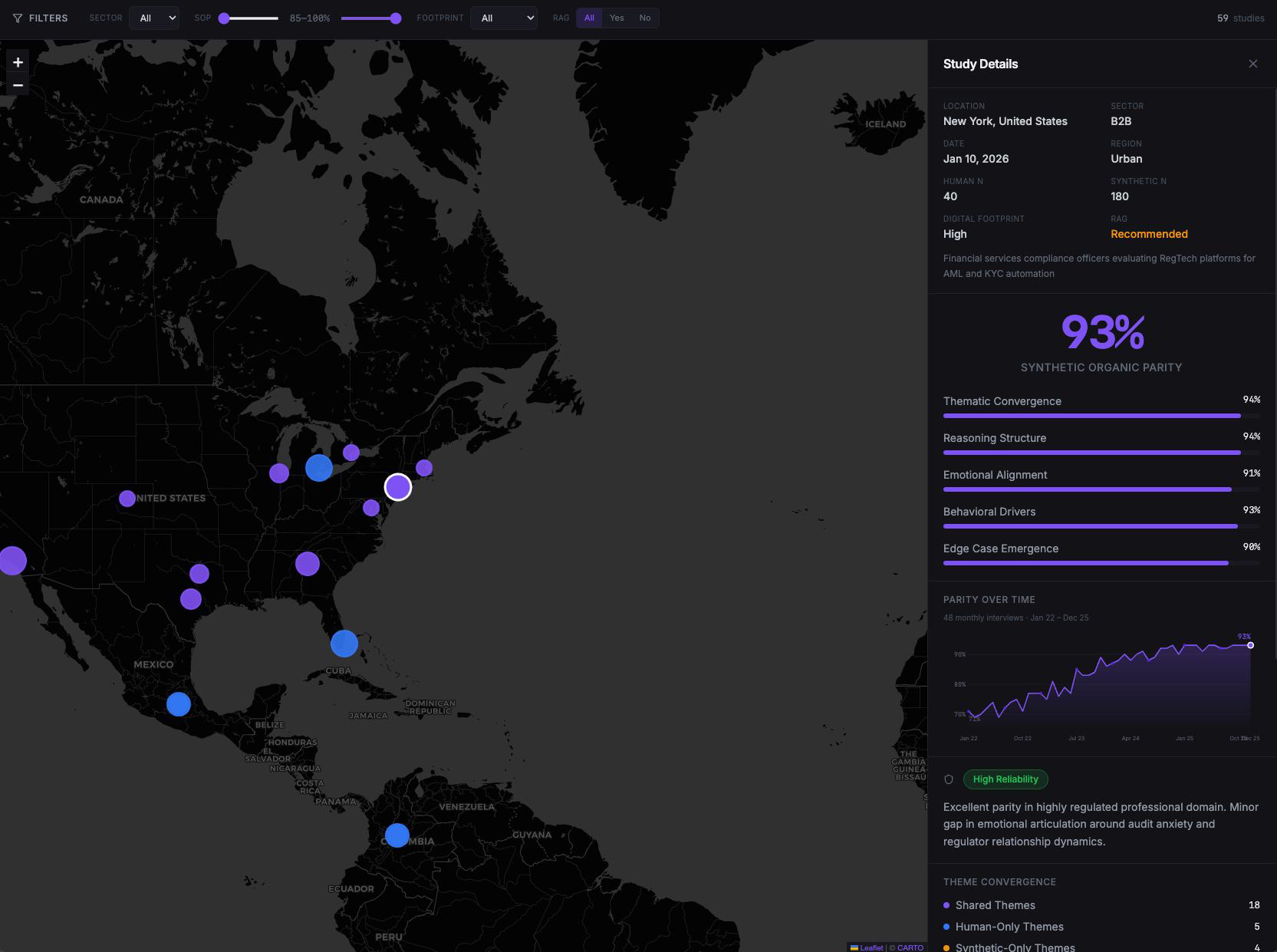
We have global coverage.
From New York to Mumbai, Synthetic Users cover urban, peri-urban, and rural audiences across regulated and consumer-facing sectors.
Highest value sits in Need Identification, Concept Testing, Development, Growth, and Maturity.
Use Synthetic Users across the whole lifecycle — they earn the most in the phases where you need many fast reads on real behaviour. An evolving picture, as we run more comparative studies.
It's worlds beyond typing into a GPT.
A strategy EVP on piloting Synthetic Users — and why a single prompt to one model doesn't come close.
We've piloted Synthetic Users and are going a step deeper now to envision a reshaped strategy workflow that starts with fast, early insights and hypotheses into multiple members of the buying team via SU. Of course we still believe in research with live humans, but depending on the project, often the work just can't wait or the budget doesn't support traditional research methods.
We're finding a hybrid approach is faster and helps us jump more quickly to foundational insights — for example, I'm in love with SU's knowledge graph output, which I use to gain deep understanding into the mental associations and forces that reinforce the status quo, and those that unlock permission to pursue or accept change.
And it's worlds beyond typing "Act as the CIO of a large public utility…" into a GPT.
Synthetic Users is a new infrastructure layer in your company.
Not another tool in the research stack — a layer underneath it. Install it once and every team taps the same calibrated synthetic mirror of your organic users: Product, Marketing, Ops, each asking their own questions of one consistent, grounded source.
Your customers and users, out in the world — the population everything is calibrated against.
Your organic users set the ground truth; the synthetic layer mirrors them; every department draws from that one layer — same grounding, traceable inputs, continuously calibrated. When your data changes, the layer updates; nobody re-recruits a panel.
Step-by-step tutorials and the science behind the platform.
Session 1 — Platform overview & first study
Workspace setup, your first project, and an exploratory study end-to-end. 28 min.
WatchSession 2 — Generative research
Open-ended questions, unexpected insights, and studies that surface what you didn't know to ask. 35 min.
WatchSession 3 — Evaluative research
Validate designs, test concepts, and measure usability with structured studies. 32 min.
WatchQuick UX testing tutorial
Upload your designs, define tasks, and watch Synthetic Users navigate your screens for usability feedback. 8 min.
WatchHow to get the most out of Synthetic Users.
A live working session with our founders and a special guest, plus an open Q&A.

Follow our YouTube channel for more tutorials.